Showing posts with label Investment Plan. Show all posts

Thursday, 18 July 2013

Investment Strategies To Beat The Market

I started this blog with the premise to inform other fellow investors out there on how to stay ahead of market cycles. To me, investment strategy should be making sound estimation of market direction ahead of the all the news and crap you hear and read about. Because reacting to news is often too late.
Today's entry is very important to me because i try to understand why the market is reacting in certain ways and why the next big crash is constantly being delayed through manipulation by central banks around the world economic powers.


The graph above clearly shows S&P movement from March'09, as it moves up in steps every time a new Quantitative Easing is introduced. Naturally this is not healthy because of the external influence QE has on the market. And we are left with conflicting data, S&P should not be so high when we still have alot of companies with reduced PE ratios, earnings and growth decline.

If you are looking for value, Europe seems to be a better option than US and Japan. Europe is more than 15% cheaper then US in terms of its P/E ratio (EURO STOXX 50-15.57 , S&P 500 - 18.43) giving it room for higher profit. 
Japanese market on the other hand, i personally will avoid because the monetary policy implemented will result in higher volatility (plus i dont really have the extra cash to gamble away). 

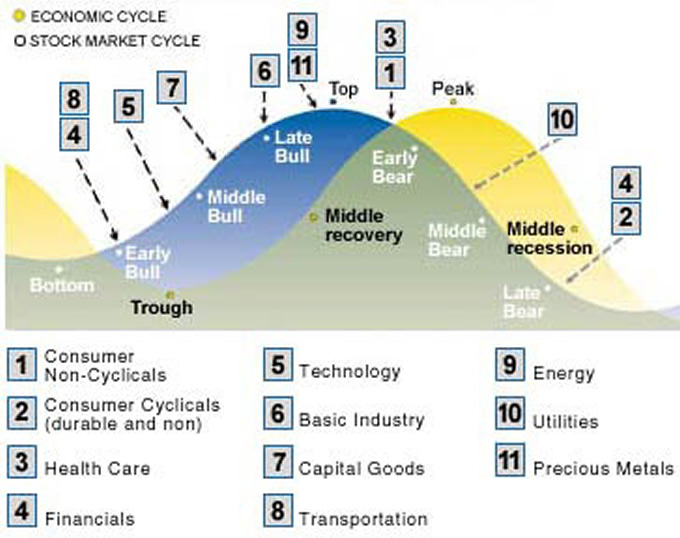
In these kind of scenarios with external influences, technical analysis becomes inaccurate and unreliable in my opinion. However one can still gear their investment strategy to pick the best sectors that perform well during late stages in a bull market. I need to pull up my favourite picture below which explains market cycles and recommendations:

I follow this graph very closely. We are in the late bull stages in the stock market cycle. For very good reason, there is no timeline on the x-axis because stock market cycle time can vary due to different influences. At this point of time i strongly recommend holding onto non-cyclicals defensive stocks such as utilities, consumer and healthcare. 
Keep your eye on opportunities in cyclical stocks such as in the luxury goods, tech stocks and financials but dont buy them yet, wait till late bear market stages. 

Dividend investing is always nice to have, keeping at least 30-40% of your portfolio based on regular dividend paying stocks is a strategy i adopt but keep a look out for dividend cuts, cancellations or script dividends.

To summarise, it seems the US market is already quite high, it would have to go to higher highs before the next market crash. This does not mean we should start worrying and panicking. The key thing would be to take profit where targets are reached, not to be greedy and keep at least 40% of your portfolio in cash by end of the late bull run. (Frankly no one knows when that might be, could be end of 2013 or could be after 1st Quarter of 2014) 

Thursday, 18 April 2013

Current Investment Strategy

Referring to my previous post, the market is due for short-term correction worldwide. I feel that the bull market is not over yet, this is only a temporary correction. I am going to liquidate 50% of my holdings and prepare to load up on stocks with higher growth potential. I say 50% (in my case) because some of my holdings have actually surpassed their target price, being greedy, I did not sell them too early. For example Cache Logistics Industrial REIT, this one is way over my valuation, it seems trading houses keep upgrading it to BUY and raising their TP. I can understand why, they also cannot determine how much higher this stock might go. If you are happy with a decent 30% profit, lock in your profits before it starts to fall. 

The other 50% of my holdings are value stocks which i will accumulate for as long as i can.(e.g. Singtel, Starhub, HPH Trust, Ascott REIT). I also hold Hyflux for the long run, not because i love it too much to let go but because i got in at a higher buy price and have been dollar-cost-averaging it down to $1.50 since 2011. (One of my biggest error in judgement, but we learn from our mistakes don't we?) Remember Warren's rule number 1: Never lose Money. 


Disclaimer: I just wanted to put down my thoughts in this post, It should NOT be taken as a basis for making any specific investment decisions.

Monday, 18 March 2013

Market Cycles

Actually there are many cycle theories, Economic/Business Cycle, Market Cycle, Presidential Cycle, holiday cycle and so on. To me, stock market and the economy moves in tandem and it is the most relevant to investors today.

According to Investopedia, Market Cycle is defined as "Trends or patterns that may exist in a given market environment, allowing some securities or asset classes to outperform other". Everything in nature has a pattern, even man-made financial systems have a pattern. I would recommend the movie "Pi" for anyone interested to learn more about patterns in man-made systems and how they display similarity to nature. A very weird but interesting movie.

Getting back to the topic, the phenomenon of market cycles exist and we as investors should take advantage of it as much as we can. Its actually quite hard to pin-point exactly what stage we are in the market cycle because of the lack of specificity. There is no specific beginning or ending to a phase. However, as with most market professionals, I agree they exist and our Investment Strategy should include short to medium term swings within the cycle.


The big question is: Where are we in the market cycle???
Well that depends on your own interpretations, you might disagree with the following. In my opinion we are in the Late Bull phase in the stock market cycle, which also corresponds to the middle of economic recovery. I am expecting a peak in Gold and commodities by 2015 but this bubble is not sustainable. It will eventually burst sometime in 2015 when we are in the middle of a recession.

Inflation and central bank interventions through monetary policy easing has actually distorted the market cycle and skewed my previous predictions. In fact, I initially anticipated a recession starting 2nd Quarter of 2013 and have made preparations for it already (by taking profits and having ready cash). Now it looks like it will be 6-12months before we get into a bear market.


Forget what investement bank guru's are telling you, they have a reputation of telling you things a little too late. It is better for you to decide for yourself. Where do you think we are in the market cycle?

Thursday, 14 March 2013

Few tips To Investment Planning


Investing requires discipline and I cannot stress enough the need to stick to certain set of rules. Lets look at a couple of rules I have agreed to before I began investing.

Rule Number 1: Make use of Compounding

Compounding is vital to grow your investments over time and anybody can do it as long as you stick to the following principles. In order to compound successfully, you need perseverance, knowledge of how it works and most importantly TIME. One should have the understanding of how compounding actually works so that he/she can stick to a savings and investment plan. I put TIME in bold because unfortunately this is no get-rich-quick scheme, compounding works only through time. But there is a catch, you MUST keep your investment money aside, that means no spending it. Although it may be boring, for people with itchy fingers want to move money around to riskier investment vehicles, just endure until such time as to when you really need the money. It should get a little more interesting after 8 to 10 years of continuous, uninterrupted compounding.
Let us look at a typical example i picked out from the internet, you can just google "power of compounding" and get so many examples.  But here's one from ICMARC website: 

http://www.icmarc.com/Images/investments/COTW/20080328startsavingearly.gif

For someone who starts contributing (annually $4k) into his retirement plan 10 years earlier can expect to compound at least twice the amount if he were to start contributing at a later time.
Another study done by Market Logic in US, shows how compounding magic can happen even if you stop contributing on a yearly basis.

Let us assume investor (B) opening a retirement fund at age 19. For 7 consecutive years, he contributes $2000  at an average growth rate of 10% (7% + interest). Then he stops putting anymore money into his retirement fund.
A second investor (A) makes no contributions until the age of 26 (same age at which investor B stops contributing to his retirement fund) but investor A starts to diligently contribute $2000 annually until he is 65 years old. (assuming the same 10% growth rate.
Look at the incredible results in the table below. Investor B ends up with higher return on investment (ROI) than A but he only contributed for 7 years (total: $14,000). Investor B on the other hand kept contributing $2000/year for 40 years. (total of 2000x40 = $80,000). The only difference being that B has had 7 more early years of compounding than A which were worth more than all of investor A's 33 additional contributions.


table1
* If you are below the age of 25 and reading this, i urge you to go and start investing little by little in your own choice of blue-chip stocks. Its not too late for your kids too, I suggest starting early for your kids. It's a study which i wish i discovered earlier because i had a "poor dad" using the definition by Robert Kiyosaki in his popular book "Rich Dad, Poor Dad". Unfortunately my father did not feel that his kids needed to learn about money, he only taught us to save, get a good job and save some more. Having a saving plan running concurrently with your investment plan is very important too, but as a rule, i never keep more than 8 months living expenses in my bank account.

Rule Number 2: Try Not to Lose Money

This may sound funny to some but i think we should have the mentality of not losing money unnecessarily. If we want to preserve our capital and eventually grow it, we must aim not to lose big money. I have noticed that most people do end up losing money through gambling, ridiculous investment schemes, poorly executed business deals, greed and often times poor market timing. Over the years, there have been so many cases in Singapore where people lost money in the stock market, options, futures, in terrible loans, mindless gambling and in their own business. This rule may be simple, but we have to be disciplined in the way we spend our money and perform due dilligence enterning into any kind of investment.

Rule Number 3: It takes Money to make Money 

The wealthy investor has a major advantage over the smalltime amateur investor, they have the MONEY. One can argue that actually the wealthy investor does not need the market, somehow the market always moves in their favour. Understand the wealthy investor's mindset, he already has all the income he needs, not depending on the investment outcome, removing all emotions out of the equation. He probabaly has money invested in BONDS, Treasury-bills, Money market funds, Stocks, Real Estate and Other Business shareholdings.

The wealthy investor is an expert is seeing VALUE. For example, he would invest in Bonds when its cheap and yields are high or move his money to Stocks when they are cheap with higher yields. With the ultimate goal of acquiring REAL ASSETS, eventually these investors buy real estate, physical gold, jewellery, expensive watches, diamonds and artwork; Things with great value. Another thing is when there is no opportunity presenting itself, they can afford to wait. We need to have patience.

What about the little guy with little or no money? They feel pressurised to make money, or SAVE, SAVE, SAVE into a bank. This is madness at current interest rates less than 1%, being offered by banks. When the small investor is not buying overvalued stocks offerting 1-2% yields, he is off to gamble away his hard earned savings like buying lottery tickets or some ridiculous get-rich quick scheme. The small investor is always trying to force the market to do something for him, he is a guaranteed loser. Without understanding VALUES, he constantly overpays swayed by his/her emotions. I like this statement which i found on the internet : "He who understands interest - earns it. He who doesn't understand interest - pays it". The poor guy usually end up in huge debts, making payments on his house, electronic equipments (Thanks to COURTS easy installment plans), loses money gambling...in short always runs after money.

So why is it that life is unfair, wealthy people always have the upper hand? I thought the poor always maintain a strict discipline of never overspending. Instead of taking his extra savings and compounding it in smart income producing securities, we always see them in debt. The usual answer is "I'm not making enough money". Although I symphathise on this situation, I know its possible to take two jobs, upgrade your skills, lower your monthly expenditure, do whatever it takes to work towards financial freedom. Be Positive. It makes alot of difference, both in one's mental attitude and in the way one actually handles one's money.

Rule Number 4: Investment Value

Usually I will suggest that one should stick to the basic compounding system and let it work over time. But if the opportunity arises when the market offer great value, Take it! [like post Dot.Com bubble (2001), Post-Subprime crisis (2008)] I would judge an investment to be of great value if it presents Lower Risk, Attractive Return(yield), Capital Appreciation. The key to making money is definitely to stay liquid, move your money from one market to another, follow the basic rule of buying undervalued investments.

Thursday, 7 March 2013

The Hidden Investor

This is my first blog post for the Hidden Investor, created to share my knowledge and ideas on investing. I hope to post some interesting articles as well and keep track of my investment journey which happens to start in 2011. Since then i have made as many terrible decisions as good ones. Hopefully someone will learn from my mistakes and profit from my experiences. This blog is for the hidden investor, who just wants to make a decent return on his/her money.

Investing is for EVERYONE and each investor should have EQUAL CHANCES to make money. We live in an unfair world, the financial system receives plenty criticism BUT still presents ample opportunities to profit from it. Yes, the hidden investors are out there predicting which way the stock or bond markets are heading to figure out which stock or fund will bring back huge profits.

Need a Plan

The basic requirement to make money is that you need to PLAN for it. Majority of investors do have some kind of plan, self-discipline and desire. It does'nt take a genius to have some sort of investment plan. I will take about investment planning in upcoming blog entries.