Mixed feeling analysing my portfolio today. I know that my entry points have not been excellent in the past for Singapore stocks. Of course over the past several years, my timing has improved. My failure to have proper exit strategy in the past has haunted me and I still hold on to my biggest losses, namely Hyflux (30% loss) and ChinaGaoxian (still 67% loss after they re-enlisted into the exchange). Those two are the main culprits. Otherwise excluding them average loss is 8%. I'm not that worried as almost 65% is allocated to REITS giving me 7% returns on average. REITs on average are not performing well. Gonna get my rights issue+access @ $1 for Ascott REIT soon, so might bring my losses down slightly.
Anyway the reason for this post is to share an interesting point here. How come SGX is lagging while the rest of the world is moving towards new highs? I really dont understand. Thank GOD, I have spread or "diversified" my portfolio to stay invested in US, Japan, HK/China as well.
(*I didnt take into account dividends)
As you can see almost 60% is parked in Singapore. Most of them are in the red but only slightly, this year end rally will help me to exit some positions with profit + dividends. As for NYSE/NASDAQ, holding mainly consumer/defensive stocks like KO and MDLZ with decent returns of 20%.
Best performing market for me is still the chinese stocks, timing was good, entry was just after the bottoming out after 3 years of sluggish growth in China. However i wish i had put more into chinese stocks. Mainly holding BYD Intl and China Insurance.
A good lesson here is to stay diversified then only you can lower your risk.
Showing posts with label Investment Strategy. Show all posts
Friday, 22 November 2013
Monday, 11 November 2013
Things To Come
This is not related to the famous science fiction book "The Shape of Things to Come" by H.G. Wells but rather my take on the stock market. Regular readers of my blog would know about my stance on the market today. Take advantage of the market exhuberance but beware of what is coming ahead in 2014. I have said in the past, history tends to repeat itself, even if the Feds keep printing money and delay the inevitable, the outcome will still be the same. Personally i have a bearish outlook for stocks in 2014, i let the chart below do most of the talking.
Eventhough we have not reached market tops, we are quite close. I think DowJones Industrial average is a better indicator of global market cycles than S&P500, Nasdaq or other indices. Of course our very own STI can tell a different story but there is a high correlation between the two.
On first look, you might say the DJIA is moving perfectly between two parallel lines but the bottom in Sep'2002 does not touch uptrending line. Another fact is that the bottom in Feb 2009 was actually lower than Sep 2002, which lets some people believe that we have been in a bear market since 2000. I however, do not think technical analysis takes into account all the things that have changed. We have not taken into account how the index NOW has more components than it did 20 years ago, the revolution of the internet and increase in accessability to trade the market. All these things add to the volatility equation.
What has happened since 1992? We have seen internet bubble and housing bubble. What has allowed for these bubbles to form? Ever since 2000, the central bank's policy has only delayed an eventual bottoming of the stock market. But i am not going to complain about that because it has made many, including myself, to get a decent return from investments.
Recent activities in the stock market and other asset classes is sending a clear signal that bubbles are forming everywhere mainly due to loose printing of money and low interest rates. Many people are quick to forget how often central bank policies have backfired throughout history, as they try to artificially quell inflation. Central bank policies have only three achievements throughout history:
1. Making a few successful traders, filthy rich over a short period of time >>> suddenly they become guru's and start conducting seminars and writing books.
2. Ensure Banks make more money, and also making the wealthy eventually wealthier
3. Eventually failing and sending the world into turmoil
What is happening recently? You must have seen Twitter jumping almost 73% on its IPO debut appearance. Everybody is probably thinking, hey i want a slice of that pie also. But did you stop and think about the business of twitter? How are they able to generate income through advertisements alone? I guess there will always be followers who will buy into the hype but i do not think its a sustainable business model, same goes for Facebook. Another internet bubble in the making perhaps.
In Asia, we see bigger bubbles forming across all asset classes. Look at the Indian stock market which has reached record highs over the past week despite all the problems and massive devaluation of its currency. Its definitely speculator's market, with no fundamentals. Look at the chart below for SENSEX, where is the supporting line for their post 2004 rally?
Housing markets in Singapore, Hong Kong, China and Australia are all in a bubble.
Australian housing market has been on an uptrend since the 1950s and is one of the world biggest housing bubble. Now Aussies are being allowed to use their "superannuation funds" as collateral to buy residential properties, reflating their bubble again. Look at the charts below:
So just beware of things to come. It is not going to get easier. Central banks around the world are clouded by their hubris, endlessly printing money and stretching without contraints. Bear in mind, our financial system as it stands today has a very short history compared to the thousands of years of written history. No body is sure how the future will play out. But i do know for sure, increasing asset price volatility is here to stay.
The best defense would be to:
1. Diversify your assets (Stocks, Commodities, Property etc.)
2. Don't take on "bad" debt. (read Robert Kiyosaki's Rich Dad Poor Dad, in case you are not sure what is good debt and bad debt.)
3. Avoid hyped up IPOs (which gets undue media attention)
4. Hold some cash reserve (SGD is still one of the best in the world)
Since last week you will hear and read in every type of media that the economy is going to get better ahead. Yes it will, I am counting on it. Just be prepared to take profit and close positions.
I leave you with a statement in an article by BoeckhInvestmentLetter which i like very much:
Eventhough we have not reached market tops, we are quite close. I think DowJones Industrial average is a better indicator of global market cycles than S&P500, Nasdaq or other indices. Of course our very own STI can tell a different story but there is a high correlation between the two.
On first look, you might say the DJIA is moving perfectly between two parallel lines but the bottom in Sep'2002 does not touch uptrending line. Another fact is that the bottom in Feb 2009 was actually lower than Sep 2002, which lets some people believe that we have been in a bear market since 2000. I however, do not think technical analysis takes into account all the things that have changed. We have not taken into account how the index NOW has more components than it did 20 years ago, the revolution of the internet and increase in accessability to trade the market. All these things add to the volatility equation.
What has happened since 1992? We have seen internet bubble and housing bubble. What has allowed for these bubbles to form? Ever since 2000, the central bank's policy has only delayed an eventual bottoming of the stock market. But i am not going to complain about that because it has made many, including myself, to get a decent return from investments.
Recent activities in the stock market and other asset classes is sending a clear signal that bubbles are forming everywhere mainly due to loose printing of money and low interest rates. Many people are quick to forget how often central bank policies have backfired throughout history, as they try to artificially quell inflation. Central bank policies have only three achievements throughout history:
1. Making a few successful traders, filthy rich over a short period of time >>> suddenly they become guru's and start conducting seminars and writing books.
2. Ensure Banks make more money, and also making the wealthy eventually wealthier
3. Eventually failing and sending the world into turmoil
What is happening recently? You must have seen Twitter jumping almost 73% on its IPO debut appearance. Everybody is probably thinking, hey i want a slice of that pie also. But did you stop and think about the business of twitter? How are they able to generate income through advertisements alone? I guess there will always be followers who will buy into the hype but i do not think its a sustainable business model, same goes for Facebook. Another internet bubble in the making perhaps.
In Asia, we see bigger bubbles forming across all asset classes. Look at the Indian stock market which has reached record highs over the past week despite all the problems and massive devaluation of its currency. Its definitely speculator's market, with no fundamentals. Look at the chart below for SENSEX, where is the supporting line for their post 2004 rally?
Housing markets in Singapore, Hong Kong, China and Australia are all in a bubble.
Australian housing market has been on an uptrend since the 1950s and is one of the world biggest housing bubble. Now Aussies are being allowed to use their "superannuation funds" as collateral to buy residential properties, reflating their bubble again. Look at the charts below:
So just beware of things to come. It is not going to get easier. Central banks around the world are clouded by their hubris, endlessly printing money and stretching without contraints. Bear in mind, our financial system as it stands today has a very short history compared to the thousands of years of written history. No body is sure how the future will play out. But i do know for sure, increasing asset price volatility is here to stay.
The best defense would be to:
1. Diversify your assets (Stocks, Commodities, Property etc.)
2. Don't take on "bad" debt. (read Robert Kiyosaki's Rich Dad Poor Dad, in case you are not sure what is good debt and bad debt.)
3. Avoid hyped up IPOs (which gets undue media attention)
4. Hold some cash reserve (SGD is still one of the best in the world)
Since last week you will hear and read in every type of media that the economy is going to get better ahead. Yes it will, I am counting on it. Just be prepared to take profit and close positions.
I leave you with a statement in an article by BoeckhInvestmentLetter which i like very much:
"The fragile state of the economy and financial system will continue to require inflation of money and credit, heavy government intrusion into the private sector, and frequent resorting to subsidies and support programs. This will continue to distort relative prices of labor, goods, services, and assets. It will sustain the economy in an artificial state and will compound instability and make it impossible to understand what is real and what is not."
Friday, 8 November 2013
Be a Dividend Investor
A dividend investors goal should be to generate a increasing stream of sustainanle dividend income, through careful selection of dividend growth stocks. Their investment plan must not be dependant on daily market fluctuations. I am not being overconfident but a dividend investor must be able to say confidently that "daily fluctuations have no bearing on my investment plan" because i have bought this stock at a great discount and will keep building on it for the next 10 or 20 years (through 2-3 market cycles).
Dividend investors out there, do not worry because most of your stocks will keep sending you dividends quarterly or annually (as long as the company is well managed, increasing in profitability year after year. What is most important is to focus on quality dividend stocks and purchase them at attractive valuations. In Singapore's short history, there are very few stocks that i can think of which have actually raised their distributions for at least ten consequtive years and may continue to do so for the next ten years.
Companies like Singtel pay out dividends regularly, and it has increased over the past 11 years. They actually are a bit unpredictible because in 2003 and 2009, there was no increase. While on some years, you would get Special dividends, which is awesome.
Take away the special dividends and other distributions and just look at Interim/Final dividends over the last 11 years and take the average:
2002 >>> 2013
5.5c >>>> 16.8c (dividends increased average 10.8% annually)
Which is not bad right?
As dividend investors, we should try and avoid unpredictability. I firmly believe that a strong management team which focuses on consistently sharing a portion of the profits with investors in the form of dividends will continue doing so, as long as the business is able to support it. Dividend Ranking website is pretty good to do the research on dividend history:
http://www.dividendsranking.com/index.php
I pulled this one for KeppelCorp from the above website:
There are of course another part of the dividend equation. In Singapore you can invest in REITs or Business trusts which promise you regular dividends (90% payout for REITs). But REITs are not the same as company stocks. They did not promise an increase in dividends over time, just that 90% of the profits will be payed out, which means if they profit less in the particular year, you get less. Obviously. So there is the risk of unpredictability.
You know i wish investing in dividend stocks could be so easy that you can just buy it and close your eyes. But you cant do that. Investors need to periodically monitor the financial health of their stocks. It should not be very complicated once you have done initial background research on the business and shareholding structure. Fundamentals of the company do not change overnight. Singtel will most likely be in the telecom business the next 10 or 20 years. Keep an eye out for news related to the particular stock such as mergers and acquisitions, that could prove very profitable or spell disaster in the making.
The bottom line is this: Market fluctuations should not scare intelligent dividend investors, instead it should be used as opportunities to build on your portfolio or trim off some profit. Steep drop in prices for dividend paying stocks provide excellent entry points for long term wealth accumulation. Personal note, Watch out for these in the next crash: Singtel, Singpost KeppelCorp, Jardine related stocks or if interested overseas, Coca cola; Colgate; Procter & Gamble; Exxonmobil; Kimberly Clark; Unilever; Merck & Co; Sanofi Aventis; Eli Lilly; Johnson & Johnson. If you noticed, Healthcare stocks have pretty good dividend payout rates but they are slow growth stocks.
Dividend investors out there, do not worry because most of your stocks will keep sending you dividends quarterly or annually (as long as the company is well managed, increasing in profitability year after year. What is most important is to focus on quality dividend stocks and purchase them at attractive valuations. In Singapore's short history, there are very few stocks that i can think of which have actually raised their distributions for at least ten consequtive years and may continue to do so for the next ten years.
Companies like Singtel pay out dividends regularly, and it has increased over the past 11 years. They actually are a bit unpredictible because in 2003 and 2009, there was no increase. While on some years, you would get Special dividends, which is awesome.
Take away the special dividends and other distributions and just look at Interim/Final dividends over the last 11 years and take the average:
2002 >>> 2013
5.5c >>>> 16.8c (dividends increased average 10.8% annually)
Which is not bad right?
As dividend investors, we should try and avoid unpredictability. I firmly believe that a strong management team which focuses on consistently sharing a portion of the profits with investors in the form of dividends will continue doing so, as long as the business is able to support it. Dividend Ranking website is pretty good to do the research on dividend history:
http://www.dividendsranking.com/index.php
I pulled this one for KeppelCorp from the above website:
There are of course another part of the dividend equation. In Singapore you can invest in REITs or Business trusts which promise you regular dividends (90% payout for REITs). But REITs are not the same as company stocks. They did not promise an increase in dividends over time, just that 90% of the profits will be payed out, which means if they profit less in the particular year, you get less. Obviously. So there is the risk of unpredictability.
You know i wish investing in dividend stocks could be so easy that you can just buy it and close your eyes. But you cant do that. Investors need to periodically monitor the financial health of their stocks. It should not be very complicated once you have done initial background research on the business and shareholding structure. Fundamentals of the company do not change overnight. Singtel will most likely be in the telecom business the next 10 or 20 years. Keep an eye out for news related to the particular stock such as mergers and acquisitions, that could prove very profitable or spell disaster in the making.
The bottom line is this: Market fluctuations should not scare intelligent dividend investors, instead it should be used as opportunities to build on your portfolio or trim off some profit. Steep drop in prices for dividend paying stocks provide excellent entry points for long term wealth accumulation. Personal note, Watch out for these in the next crash: Singtel, Singpost KeppelCorp, Jardine related stocks or if interested overseas, Coca cola; Colgate; Procter & Gamble; Exxonmobil; Kimberly Clark; Unilever; Merck & Co; Sanofi Aventis; Eli Lilly; Johnson & Johnson. If you noticed, Healthcare stocks have pretty good dividend payout rates but they are slow growth stocks.
Monday, 16 September 2013
Building a Dividend Portfolio
I came across a really good article on SeekingAlpha.com and i want to share it. It is called "DIY Dividend Investors Club: Building a Sustainable long term dividend portfolio". Although it is based in the US, many principles can be reused in Singapore. We can even invest in those stocks they have highlighted. They are great dividend plays, some of the most well established companies in the world. They sell things that we need everyday of our lives to make our day a little easier. [eg. Coca cola - soft drinks, Kimberly Clark - tissue/toilet paper, Colgate - toothpaste, Unilever - various consumer goods, Procter & Gamble - Various consumer goods, Mcdonalds, Wal-Mart etc.] This is only Part I, they are going to publish more parts in the future. Do look out for them.
However my key issue with investing in the US for dividends has always been the 30% tax they charge on all dividends!! There is a way to get around this if you are a long term investor, engage in Dividend Reinvestment Scheme if the company allows it.
Tried to do this, a year ago but I have fallen flat in my search to establish something, my broker at OCBC said "we don't have such scheme". I gave up for the time being. If anybody knows how to escape the 30% tax, do let me know.
I think i read somewhere that if you open an account with an US trading platform, they hold your investments in their custodian account and reinvest the dividends to buy in more units each time. I am still quite a noob when it comes to investments.
Meanwhile FEELING INSPIRED; I am thinking of adapting this strategy to Singapore stocks with the following aims:
- Portfolio Size: $100,000
- Target # of Stocks: 5-10
- Maximum Stock Concentration: 10.0% of portfolio
- Maximum Sector Concentration: 20.0% of portfolio
- Maximum High Yield Concentration: 20.0% of portfolio
- Minimum Dividend Yield: 5.0%
Its entirely possible to build a dividend portfolio in Singapore with the expectations to earn a minimum of 5% per year. Lets see how it goes, It will be a 20 year plan starting from 2014.
Tuesday, 10 September 2013
Market Sentiment vs My Sentiment
Past few weeks I am finding it difficult to adjust my sentiments to how it is being played in the stock markets. Referring to my previous post in mid August "Final Push", It is getting harder to stand my ground or belief that there will be a final bull swing before another major crash. Since the month of August has been a bloody one, markets all around the world taking a huge hit. If there is one thing i still do believe in, its that always stick to valuations.
Chinese stocks for me seemed undervalued with a lot of upside. My timing has never been perfect but my investments in China Life Insurance and BYD have yet to drop below my buying price, which tells me that I bought them at strong support levels.
On the other hand, Singapore stocks have not fared well in the past few weeks. Mixed feelings arise as prices drop reducing my profits but also creating opportunities to add into my portfolio.
As for REITs, where do i begin? Sabana REIT has fallen by almost 20cents/share. Cache REIT (see pic below) It has become even more attractive at $1.10 - $1.20 range. Since their dividend payouts will give you >7% for just holding onto it at those prices. I am happy to hold onto my shares of CACHE but not going to buy at those levels. Since the last drop broke through their supporting trendline, technically there is no way i can say with confidence that it has reached a bottom. I have a feeling it will keep falling to the dollar region before news around properties and interest rates are not looking good. People (investors) are anxious about REITs and the smart ones are pulling their money out of it. As for me, It would make sense to buy more below $1.00.
Ascott REIT also tells a similar story but it has not seen such a big drop. Maybe the investors of Ascott REIT know what a great investment it is. Especially since they are expanding strategically into rest of Asia. I like their business plan, and their dividend payouts even more. Its a steady stream of income. Just a note of the price levels. It has been trading around $1.20 this week, going forward, I think it will come back up to >$1.35, no doubt.
Those people who missed the opportunity to get a piece of this REIT should do so before its too late (*Of course do you own research first and then make an informed decision)
Here the graph of Ascott REIT below:
Yes it has crossed the supporting trendline (that is worrying me) but it is being supported by a resistance turned support line at $1.15. Also note the volume being traded. Comparing it to CACHE REIT above, volumes being traded are below low. At $1.20 it is still very attractive to me. I have to say, still not worth add onto my position unless i get it at close to a dollar.
I suppose my investment philosophy is simple. Always reserve money for further reinforcements. Usually break up your investments into 4 parts. Buy in more as it gets cheaper. Sell it higher to reap the benefits if the stock is not worth holding onto. Don't speculate and dont surround yourself with negative thoughts. There will also be people telling you negative things, "Get out now, while you still can" and "I told you so". You decide when its time to get out. Patience is a virtue, so be patient. If you have been following my blog posts, you will realise that we are still in the late stages of a 3 year bull market. I would start to worry in the 1st quarter of 2014.
Chinese stocks for me seemed undervalued with a lot of upside. My timing has never been perfect but my investments in China Life Insurance and BYD have yet to drop below my buying price, which tells me that I bought them at strong support levels.
On the other hand, Singapore stocks have not fared well in the past few weeks. Mixed feelings arise as prices drop reducing my profits but also creating opportunities to add into my portfolio.
As for REITs, where do i begin? Sabana REIT has fallen by almost 20cents/share. Cache REIT (see pic below) It has become even more attractive at $1.10 - $1.20 range. Since their dividend payouts will give you >7% for just holding onto it at those prices. I am happy to hold onto my shares of CACHE but not going to buy at those levels. Since the last drop broke through their supporting trendline, technically there is no way i can say with confidence that it has reached a bottom. I have a feeling it will keep falling to the dollar region before news around properties and interest rates are not looking good. People (investors) are anxious about REITs and the smart ones are pulling their money out of it. As for me, It would make sense to buy more below $1.00.
Ascott REIT also tells a similar story but it has not seen such a big drop. Maybe the investors of Ascott REIT know what a great investment it is. Especially since they are expanding strategically into rest of Asia. I like their business plan, and their dividend payouts even more. Its a steady stream of income. Just a note of the price levels. It has been trading around $1.20 this week, going forward, I think it will come back up to >$1.35, no doubt.
Those people who missed the opportunity to get a piece of this REIT should do so before its too late (*Of course do you own research first and then make an informed decision)
Here the graph of Ascott REIT below:
Yes it has crossed the supporting trendline (that is worrying me) but it is being supported by a resistance turned support line at $1.15. Also note the volume being traded. Comparing it to CACHE REIT above, volumes being traded are below low. At $1.20 it is still very attractive to me. I have to say, still not worth add onto my position unless i get it at close to a dollar.
I suppose my investment philosophy is simple. Always reserve money for further reinforcements. Usually break up your investments into 4 parts. Buy in more as it gets cheaper. Sell it higher to reap the benefits if the stock is not worth holding onto. Don't speculate and dont surround yourself with negative thoughts. There will also be people telling you negative things, "Get out now, while you still can" and "I told you so". You decide when its time to get out. Patience is a virtue, so be patient. If you have been following my blog posts, you will realise that we are still in the late stages of a 3 year bull market. I would start to worry in the 1st quarter of 2014.
Monday, 12 August 2013
Final Push
I have been very quiet the past few weeks for 3 main reasons:
1. There was little movement in the stock market
2. Been away for business trips past 2 weeks
3. Time to relax and enjoy the double combo holiday: Hari Raya + National Day
However the timing seems to be right, everything seems to be setting up as expected. Its nearing the final push for the stock market. I expect to see a perfect bull trap being set up by 1Q 2014. Hopefully by then I will have the opportunity to divest 60% of my portfolio in preparation for the next bear market.
(refer to previous article for chart:
http://hiddeninvestor.blogspot.sg/2013/07/hectic-june-but-quiet.html )
One fine example is ExxonMobil, I am waiting for the final push in the next half year because i expect oil prices to increase, and oil producers to benefit in the short term. Exxonmobil has the potential to break into the $100+ region, being supported by both the bullish trendline and resistance turned support at $90 region. I am hoping their final push will be fruitful for all invested in its share. But be weary of what is to follow after the next peak is reached.
Disclaimer: The above estimation of market movement/direction is solely based on my opinion. Please conduct your own research or engage in a professional financial expert before making any investment decisions.
1. There was little movement in the stock market
2. Been away for business trips past 2 weeks
3. Time to relax and enjoy the double combo holiday: Hari Raya + National Day
However the timing seems to be right, everything seems to be setting up as expected. Its nearing the final push for the stock market. I expect to see a perfect bull trap being set up by 1Q 2014. Hopefully by then I will have the opportunity to divest 60% of my portfolio in preparation for the next bear market.
(refer to previous article for chart:
http://hiddeninvestor.blogspot.sg/2013/07/hectic-june-but-quiet.html )
One fine example is ExxonMobil, I am waiting for the final push in the next half year because i expect oil prices to increase, and oil producers to benefit in the short term. Exxonmobil has the potential to break into the $100+ region, being supported by both the bullish trendline and resistance turned support at $90 region. I am hoping their final push will be fruitful for all invested in its share. But be weary of what is to follow after the next peak is reached.
Disclaimer: The above estimation of market movement/direction is solely based on my opinion. Please conduct your own research or engage in a professional financial expert before making any investment decisions.
Thursday, 18 July 2013
Investment Strategies To Beat The Market
I started this blog with the premise to inform other fellow investors out there on how to stay ahead of market cycles. To me, investment strategy should be making sound estimation of market direction ahead of the all the news and crap you hear and read about. Because reacting to news is often too late.
Today's entry is very important to me because i try to understand why the market is reacting in certain ways and why the next big crash is constantly being delayed through manipulation by central banks around the world economic powers.
The graph above clearly shows S&P movement from March'09, as it moves up in steps every time a new Quantitative Easing is introduced. Naturally this is not healthy because of the external influence QE has on the market. And we are left with conflicting data, S&P should not be so high when we still have alot of companies with reduced PE ratios, earnings and growth decline.
If you are looking for value, Europe seems to be a better option than US and Japan. Europe is more than 15% cheaper then US in terms of its P/E ratio (EURO STOXX 50-15.57 , S&P 500 - 18.43) giving it room for higher profit.
Japanese market on the other hand, i personally will avoid because the monetary policy implemented will result in higher volatility (plus i dont really have the extra cash to gamble away).
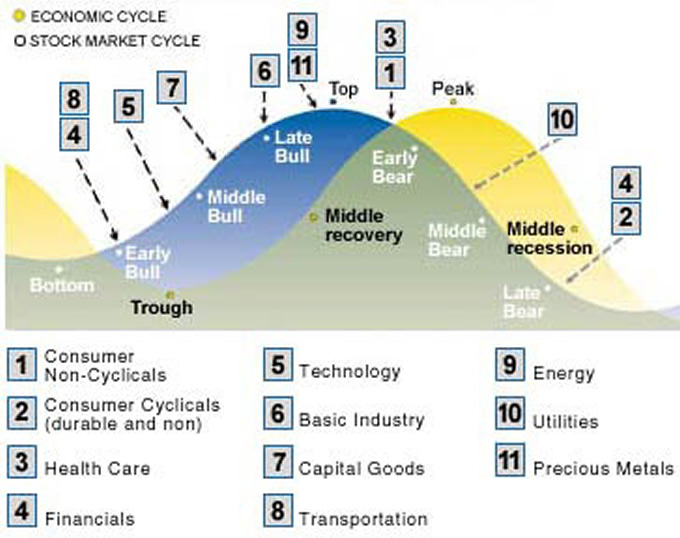
In these kind of scenarios with external influences, technical analysis becomes inaccurate and unreliable in my opinion. However one can still gear their investment strategy to pick the best sectors that perform well during late stages in a bull market. I need to pull up my favourite picture below which explains market cycles and recommendations:
I follow this graph very closely. We are in the late bull stages in the stock market cycle. For very good reason, there is no timeline on the x-axis because stock market cycle time can vary due to different influences. At this point of time i strongly recommend holding onto non-cyclicals defensive stocks such as utilities, consumer and healthcare.
Keep your eye on opportunities in cyclical stocks such as in the luxury goods, tech stocks and financials but dont buy them yet, wait till late bear market stages.
Dividend investing is always nice to have, keeping at least 30-40% of your portfolio based on regular dividend paying stocks is a strategy i adopt but keep a look out for dividend cuts, cancellations or script dividends.
To summarise, it seems the US market is already quite high, it would have to go to higher highs before the next market crash. This does not mean we should start worrying and panicking. The key thing would be to take profit where targets are reached, not to be greedy and keep at least 40% of your portfolio in cash by end of the late bull run. (Frankly no one knows when that might be, could be end of 2013 or could be after 1st Quarter of 2014)
Today's entry is very important to me because i try to understand why the market is reacting in certain ways and why the next big crash is constantly being delayed through manipulation by central banks around the world economic powers.
The graph above clearly shows S&P movement from March'09, as it moves up in steps every time a new Quantitative Easing is introduced. Naturally this is not healthy because of the external influence QE has on the market. And we are left with conflicting data, S&P should not be so high when we still have alot of companies with reduced PE ratios, earnings and growth decline.
If you are looking for value, Europe seems to be a better option than US and Japan. Europe is more than 15% cheaper then US in terms of its P/E ratio (EURO STOXX 50-15.57 , S&P 500 - 18.43) giving it room for higher profit.
Japanese market on the other hand, i personally will avoid because the monetary policy implemented will result in higher volatility (plus i dont really have the extra cash to gamble away).
In these kind of scenarios with external influences, technical analysis becomes inaccurate and unreliable in my opinion. However one can still gear their investment strategy to pick the best sectors that perform well during late stages in a bull market. I need to pull up my favourite picture below which explains market cycles and recommendations:
I follow this graph very closely. We are in the late bull stages in the stock market cycle. For very good reason, there is no timeline on the x-axis because stock market cycle time can vary due to different influences. At this point of time i strongly recommend holding onto non-cyclicals defensive stocks such as utilities, consumer and healthcare.
Keep your eye on opportunities in cyclical stocks such as in the luxury goods, tech stocks and financials but dont buy them yet, wait till late bear market stages.
Dividend investing is always nice to have, keeping at least 30-40% of your portfolio based on regular dividend paying stocks is a strategy i adopt but keep a look out for dividend cuts, cancellations or script dividends.
To summarise, it seems the US market is already quite high, it would have to go to higher highs before the next market crash. This does not mean we should start worrying and panicking. The key thing would be to take profit where targets are reached, not to be greedy and keep at least 40% of your portfolio in cash by end of the late bull run. (Frankly no one knows when that might be, could be end of 2013 or could be after 1st Quarter of 2014)
Tuesday, 16 July 2013
Being diversified is not a bad thing, or is it?
Sometime i wonder if being too diversified is a bad thing? The biggest fear is not being able to react quickly enough to a global crisis like the one we experienced not too long ago. In the event of a market crash, i hope to reduce all exposure to US, Japan and HK and 50% of SG. Meanwhile it would be unwise to take advantage of the wonderful opportunity presented to us living in Singapore, the opportunity to play almost any market in the world. What is your exposure level to world markets?
I also analysed my investments in terms of sectors, the graph is below. I usually pay more attention to sectors because of the fact that certain sectors perform better during certain times of the year and during market cycles. You will notice that my exposure to commodities sector is minimal and i would keep it under 10%. I realise my exposure to REITs is 30% but i am not worried because they are mainly hospitality REITs for example Ascott and FarEast. I would be worried if REITs which are overvalued, for example FIRST REIT, K-REIT or CMA. All in all, I am gearing towards defensive stocks more hence my exposure to Consumer and Life Insurance sector. Which sectors should i get out of by end of this year? Definitely Oil & Gas, Commodities, Utilities and Manufacturing.
Monday, 15 July 2013
In Search of Fair Value
One can get carried away when there are quite a few undervalued stocks after the recent market pullback. I certainly am not the only one who can see tremendous value in chinese stocks after it has been steadily declining since 2008. When it comes to stock picking, pick the winners or wonderful companies at fair value. Stay away from laggards at all cost.
It is the perfect time to reflect on a wise saying:
It's Far Better to Buy a Wonderful Company at a Fair Price than a Fair Company at a Wonderful Price - Warren Buffett
I should also give you example of a company i am staying away from. Petrobrasil (PBR) which recently broke through its lowest price of $13.50. I just dont know where the bottom is anymore because it is an great price for a company that is just not doing well. And if you look at the chart below from 2002, it seems the bottom was actually around US$3/share.
In terms of companies listed in SGX, HPH trust is still cheap because i see shipping business picking up rest of the year. And as talks between China and US to improve trade relations continue, trading volume will go up for the rest of this year. Take positions early and get out as soon as everyone else starts getting greedy. Because people are still fearful now, which tells me to do exactly the opposite. Also the VIX (volatility index) is going down, which if you already know indicates that we might see market uptrend soon.(below 15 is good, below 10 even better)
It is the perfect time to reflect on a wise saying:
It's Far Better to Buy a Wonderful Company at a Fair Price than a Fair Company at a Wonderful Price - Warren Buffett
Recently bought a piece of ChinaLife insurance, which is undervalued by the way. It is THE biggest life insurance companies in the world and i see great potential for it to grow in the near future as lower middle class people in China begin to be able to afford insurance policies. Another reason for investing in insurance is because of the nature of its business, which i like. Its the best kind of business after casino business because people will continue to pay you monthly until he/she reaches their retirement age of their policy lapses. Can i call it legalised "protection money"? However negative my viewpoint may be of this kind of business, i still acknowledge that the business model behind insurance companies has huge potential to make returns even during a market downturn. Therefore you many notice that insurance companies even if affected by market swings, are usually the first companies to bounce back. Anyway i am taking a long term view of China Life insurance and anything below HKD19/share is a fair value for a wonderful company. Below is the chart. I must say it is not the best technical analysis but i see strong support around HKD18, it keeps bouncing off around that price.
I should also give you example of a company i am staying away from. Petrobrasil (PBR) which recently broke through its lowest price of $13.50. I just dont know where the bottom is anymore because it is an great price for a company that is just not doing well. And if you look at the chart below from 2002, it seems the bottom was actually around US$3/share.
In terms of companies listed in SGX, HPH trust is still cheap because i see shipping business picking up rest of the year. And as talks between China and US to improve trade relations continue, trading volume will go up for the rest of this year. Take positions early and get out as soon as everyone else starts getting greedy. Because people are still fearful now, which tells me to do exactly the opposite. Also the VIX (volatility index) is going down, which if you already know indicates that we might see market uptrend soon.(below 15 is good, below 10 even better)
Monday, 8 July 2013
Hectic June but quiet
It has been a hectic time in June in both at my work and financial markets worldwide. I have been quietly watching the markets for opportunities and let me tell you..opportunities are plenty right now. Most counters in Singapore have been correcting to attractive buy levels, but not all. My hands are itchy but i refrain myself from going crazy. Prior to June, i already reduced my exposure in volatile stocks and started to hold onto more cash. Hope you did the same...because short terms corrections do occur during a bull run. Personally i believe we are not hitting peak levels YET. I may be dead wrong and we are actually in the starting phases of a full blown market crash. I am still doubtfull. So lets get help from this famous chart below:
Could this be the perfect bull trap right now? YES
Could this be just a normal correction before we head to higher highs (pre 2008)? YES
I guess we will only know for sure when it is over. My only advice is stick to valuations which are realistic. For example, Starhub has dropped 12% from its peak at $4.70 to $4.10 level now. Yes it is cheaper but i wouldn't put a single cent into it now because it is still too expensive. On the other hand, Chinese stocks have really been doing down ALOT and offer great value, have a look at China Life Insurance, the biggest life insurance company in the world.
Could this be the perfect bull trap right now? YES
Could this be just a normal correction before we head to higher highs (pre 2008)? YES
I guess we will only know for sure when it is over. My only advice is stick to valuations which are realistic. For example, Starhub has dropped 12% from its peak at $4.70 to $4.10 level now. Yes it is cheaper but i wouldn't put a single cent into it now because it is still too expensive. On the other hand, Chinese stocks have really been doing down ALOT and offer great value, have a look at China Life Insurance, the biggest life insurance company in the world.
Tuesday, 11 June 2013
Aussie Economy in Turmoil
Last year, i was contemplating on opening a AUD fixed deposit, but interest rates were dropping, AUD/USD rate was also peaking. Thank GOD i didnt. Recent events have peaked my interest again in the Aussie Dollar though.
AUD/USD fell to its lowest level in more than 2 years, home-loans are slowing down and it does not look like a safe-haven currency anymore as their interest rate advantage narrows. It has taken surprisingly long for this correction to happen. I believe this is because of speculation around the US Feds announcement that it will reduce stimulus this year.
The only things going for Australia were demand for its Housing and Commodity (mainly from China). This even helped Australia escape a big economic bust in 2008, however things are looking bad now. China is slowing down definitely but still growing at a slower pace...and i hate using the terms "hard or soft landing".
Australia's labour costs are ridiculously high, their housing bubble has BURST and their commercial real estate can only go down from here. SO have a look at the Real Home Price Index Chart over a period of more than 100years. Aussie housing market has been truly sitting in a bubble waiting to burst. At the risk of sounding like Alessio Rastani, yes i do dream of recession, make things cheaper for the average investor like me.
AUD/USD fell to its lowest level in more than 2 years, home-loans are slowing down and it does not look like a safe-haven currency anymore as their interest rate advantage narrows. It has taken surprisingly long for this correction to happen. I believe this is because of speculation around the US Feds announcement that it will reduce stimulus this year.
The only things going for Australia were demand for its Housing and Commodity (mainly from China). This even helped Australia escape a big economic bust in 2008, however things are looking bad now. China is slowing down definitely but still growing at a slower pace...and i hate using the terms "hard or soft landing".
Australia's labour costs are ridiculously high, their housing bubble has BURST and their commercial real estate can only go down from here. SO have a look at the Real Home Price Index Chart over a period of more than 100years. Aussie housing market has been truly sitting in a bubble waiting to burst. At the risk of sounding like Alessio Rastani, yes i do dream of recession, make things cheaper for the average investor like me.
Tuesday, 4 June 2013
First REIT pullback
Been watching REITs closely for some time now. The recent pullback in REITs has me more interested for 2 reasons:
-Their still relatively high yields
-Healthy correction driven mostly by FEAR
Of particular interest is First REIT because of the fact that i like the business sector they are in: Hospitals/Nursing Homes in Indonesia/Singapore/Korea. They have shown themselves to be aggressive in expansion and since 2009, their stock price have gone up significantly from 30cents a piece to almost 1.44 at its recent peak.
At the moment, the counter is undergoing a retracement to 23.6% on the Fibo chart, testing levels on $1.17 so i am happy to see this an another opportunity to get into this again. But i would wait until 50% retracement from its peak to $0.99. Am i being too ambitious? According to the chart though, a 50% retracement correlates with the major supporting uptrend for the past 4 years. Something to note here: we are seeing low volumes being traded.
I regretted selling FirstREIT prematurely at $1.04 but was happy to clock in almost 30% profit last year. Maybe this pullback is going to be a good chance for other people who have been sitting in the sidelines.
Most of the REITs are displaying similar behaviour, I just feel there has been some profit taking from retail investors and institutional investors alike, the general market trend still Bullish. Its not over till the fat lady sings. At the moment though, just sit back and wait till markets stabilise before going in again. Here is Keppel REIT analysis below which is similar retracement but general trend still upwards:
-Their still relatively high yields
-Healthy correction driven mostly by FEAR
Of particular interest is First REIT because of the fact that i like the business sector they are in: Hospitals/Nursing Homes in Indonesia/Singapore/Korea. They have shown themselves to be aggressive in expansion and since 2009, their stock price have gone up significantly from 30cents a piece to almost 1.44 at its recent peak.
At the moment, the counter is undergoing a retracement to 23.6% on the Fibo chart, testing levels on $1.17 so i am happy to see this an another opportunity to get into this again. But i would wait until 50% retracement from its peak to $0.99. Am i being too ambitious? According to the chart though, a 50% retracement correlates with the major supporting uptrend for the past 4 years. Something to note here: we are seeing low volumes being traded.
I regretted selling FirstREIT prematurely at $1.04 but was happy to clock in almost 30% profit last year. Maybe this pullback is going to be a good chance for other people who have been sitting in the sidelines.
Most of the REITs are displaying similar behaviour, I just feel there has been some profit taking from retail investors and institutional investors alike, the general market trend still Bullish. Its not over till the fat lady sings. At the moment though, just sit back and wait till markets stabilise before going in again. Here is Keppel REIT analysis below which is similar retracement but general trend still upwards:
Note: High volume traded recently suggest there might not be much reversal for Keppel REIT. But the bottom uptrend line is still intact. Currently resistance turned support line @ 1.40 is being tested. Wait and see if this breaks down.
Disclaimer: We have not reached a market peak yet but dont take my word for it. Do your own research before making any investment decision. We could as well be experiencing the beginning of a downward trend.
Subscribe to:
Posts (Atom)